
%20.png)

Best Private Jets for Short Runways

The first question we usually get about a restricted airfield is which aircraft has the shortest take-off run, as though the number at the top of the list settles it. It rarely does. Published figures come from one specific set of conditions, and your flight will not match them. Weight matters, and so does what goes into the aircraft: passengers, luggage and the fuel needed to reach the destination without a technical stop. Add heat, elevation, an unpaved or wet surface, or a long onward leg, and the shortlist can change entirely.
What follows are the aircraft that tend to hold up well on shorter runways. None of them clears a particular airport on the strength of a published figure alone. That comes from running the performance numbers for the flight in front of you.
Which Private Jets Are Best Suited to Short Runways?
The aircraft below all operate from under 1,000 m, and the shortest needs a little over 600 m. They are ordered by balanced field length at maximum take-off weight, so number one asks for the least runway.
It is not a complete list. The Citation M2, CJ2+, CJ3+, Mustang and XLS all work comfortably inside a kilometre or so and we place them regularly. These are the aircraft that come up most often when the runway is what decides the answer rather than the cabin or the price.
What the figures assume
Balanced field length is a take-off measurement taken at maximum weight, on a paved and level runway, in standard conditions at sea level.
The weight part cuts both ways, and it is the reason a published figure settles less than it appears to. An aircraft rarely departs full, so fewer passengers and fuel for the leg rather than a long-range load can bring the distance down substantially, and several of the aircraft below work from runways shorter than the figure against their name. Loaded to the limit, the same aircraft needs every metre and sometimes more. Heat and elevation push the requirement up and compound each other. Surface lengthens the roll on grass or gravel, and an upward gradient shortens what you effectively have.

1. Cirrus Vision Jet SF50
Approximate balanced field length: 610m
The Vision Jet has the shortest field requirement of any jet in production. Four passengers realistically, limited baggage, and legs of two hours or less, so it is a specific answer rather than a general one. Field performance also does not override access rules, and it is not among the certified types at the restricted-access airfields further down this list.
2. Pilatus PC-12
Approximate balanced field length: 780m
The PC-12 is a single-engine turboprop seating six to eight, approved for grass and gravel. Pressurised, quick enough to make a two-hour leg comfortable, and a cabin clients notice, which is a lot to get from an aircraft needing under 800 m of runway.
Saint Barthélemy is the clearest case for it. The runway is 646 m, with an approach over the ridge at Col de la Tourmente and access restricted to certified types flown by specially qualified crews. The PC-12 is on that list and it is the aircraft we place there most often, departing well below maximum weight on a handful of passengers and fuel for a short leg, which is what brings the distance required inside the runway available. Larger groups fly a jet into Sint Maarten and take the short hop across.
3. Beechcraft King Air 350i
Approximate balanced field length: 810m
The King Air 350i is a twin-engine turboprop seating eight to nine, with effectively the same field performance as the PC-12, a wider cabin and a second engine. Where an operator's insurance or a client's preference rules out single-engine operation, this is the aircraft that fills the gap without asking for more runway
4. Pilatus PC-24
Approximate balanced field length: 890m
The PC-24 is the only jet that gets near turboprop field performance, and the only one approved for unpaved surfaces. Flat floor, cargo door, jet speed, and a short gravel strip with a long leg attached is the flight it was built for. Access rules still apply, so it does not solve the restricted airfields, but nothing else covers the same ground.
5. Embraer Phenom 300E
Approximate balanced field length: 978m
Around 2,010 nm and eight to nine seats on under a kilometre of runway, which is why the Phenom 300 series is the most-chartered light jet in the market. Better field performance than most aircraft of comparable range, and the type to ask about first when a short runway is the constraint rather than the cabin. The Citation CJ3+ sits within 30 m of it on field length and matches it on range, so the two are usually worth quoting together and availability tends to decide it.
La Môle, serving Saint-Tropez, is where this class reaches its limit. The runway is 1,000 m and light jets are the largest category operating there in practice. It is our most frequent short-runway request in the South of France through July and August. Groups too large for a light jet go into Nice, which is 40 minutes by road in winter and considerably longer in season.

What the list does not settle
Five figures in a row look conclusive. They narrow the shortlist, and that is all they do.
The calculation that decides it runs the aircraft against the day: actual take-off weight with your passengers and bags loaded, fuel for the route, forecast temperature at your departure slot, runway condition on arrival, and the performance needed to clear terrain on the way out. The same aircraft on the same runway can be clear in the morning and restricted by mid-afternoon.
We run those numbers before confirming any flight into a restricted field, and they occasionally return a different aircraft from the one requested. A client booked on a light jet in July with a full cabin and bags for two weeks can end up on the next size up, not because the runway changed but because the load and the temperature did.
If you have a short runway at either end of a trip, send us the route, the dates and the passenger and baggage count, and we will come back with what actually works rather than what the published figures suggest.
Frequently Asked Questions
What counts as a short runway for a private jet?
Below about 1,200 m, or 4,000 ft, a runway starts ruling aircraft out. Under 1,000 m the field narrows to light jets and turboprops, and under 800 m it is turboprops almost exclusively. Elevation moves that threshold, so a long runway at altitude can demand more of an aircraft than a short one at sea level.
What gives an aircraft short-field performance?
Wing loading does most of it. An aircraft carrying less weight per unit of wing area flies at a lower speed, so it needs less runway to reach that speed and less again to stop, which is why a PC-12 outperforms jets with far more thrust. High-lift flaps, trailing-link gear and effective braking do the rest. Unpaved approval is a separate certification and governs surface rather than distance.
How does altitude affect runway performance?
Thinner air reduces engine thrust and wing lift together, so an aircraft needs a longer run to get airborne. Heat compounds it, which is why mountain airports are most restrictive on summer afternoons. The usual result is a weight restriction rather than a refusal: the flight goes with fewer passengers, less baggage or less fuel, sometimes with a technical stop that would not be needed from sea level.
Which private jets can use London City?
The runway is 1,508 m, which most business jets clear comfortably, but the 5.5-degree approach requires specific type certification and crew qualification. Aircraft with better field performance are excluded and aircraft with worse are permitted. The types we place there most often are the Citation Mustang, CJ2+, XLS and Latitude.
Can a private jet land at Courchevel?
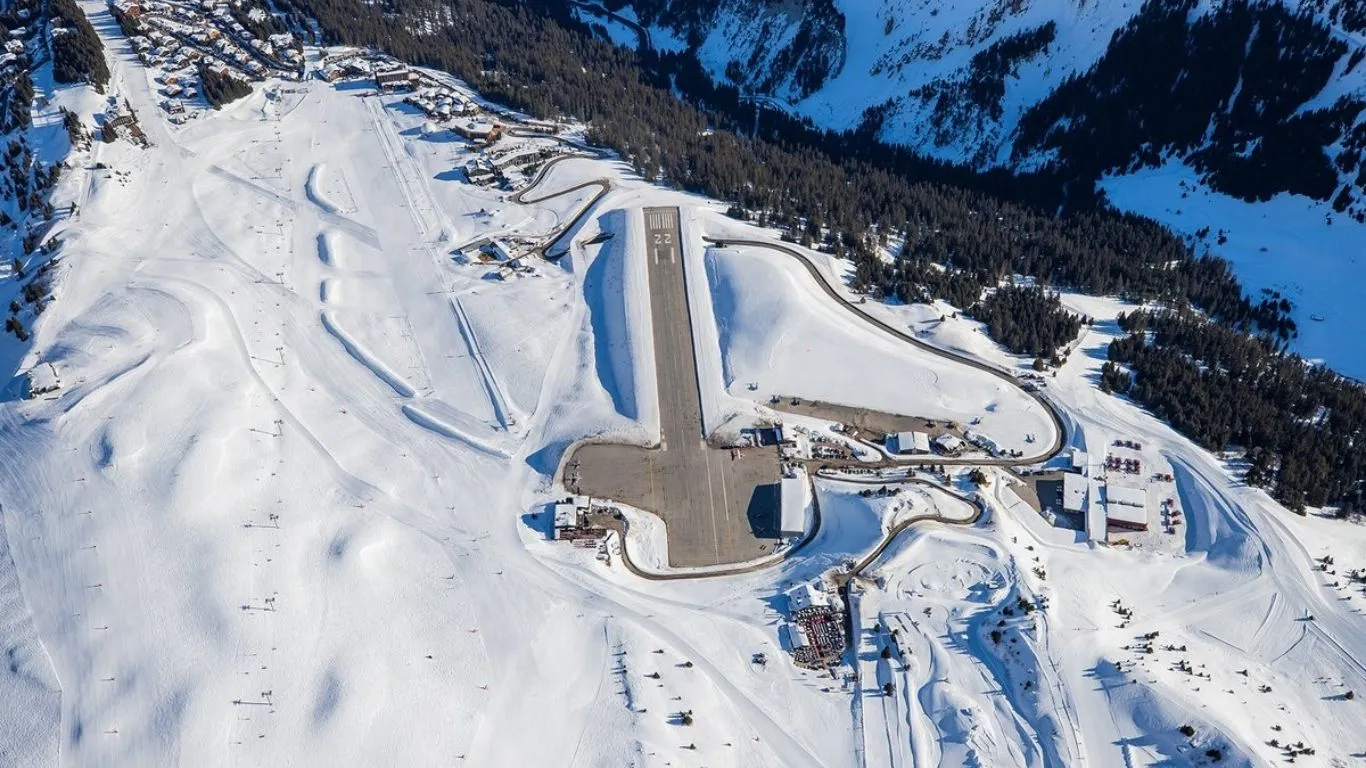
Not in practice. The altiport is restricted to a small number of certified turboprops flown by mountain-rated crews, and the factored landing distance required for commercial charter puts the 537 m runway out of reach for most operations. Clients flying to Courchevel land at Chambéry, Geneva or Lyon and transfer by helicopter or road.
Written by Alex Peake
Director of Charter at Global Charter