
%20.png)

A Guide to Private Jet Wi-Fi

Reliable onboard internet has become an increasingly important part of private jet charter. While many private jets now offer Wi-Fi, the quality of connectivity can vary significantly depending on the aircraft, the system installed, and the route being flown. With new technologies such as Starlink reshaping passenger expectations, understanding the availability, performance, and cost of private jet Wi-Fi is more important than ever.
Do Private Jets Have Wi-Fi?
Yes, many private jets now offer onboard Wi-Fi, particularly midsize, super-midsize and large-cabin aircraft designed for business and long-range travel. However, the quality of the connection can vary significantly depending on the aircraft, the system installed, and the route being flown.
While some light jets may offer limited internet access, larger aircraft are increasingly equipped with high-speed satellite connectivity that supports everything from email and messaging to video calls and streaming.
How Does Wi-Fi Work on Private Jets?
Private jet Wi-Fi is delivered through two main categories of systems: air-to-ground connectivity and satellite-based connectivity. The system installed onboard determines coverage, speed, and overall reliability.
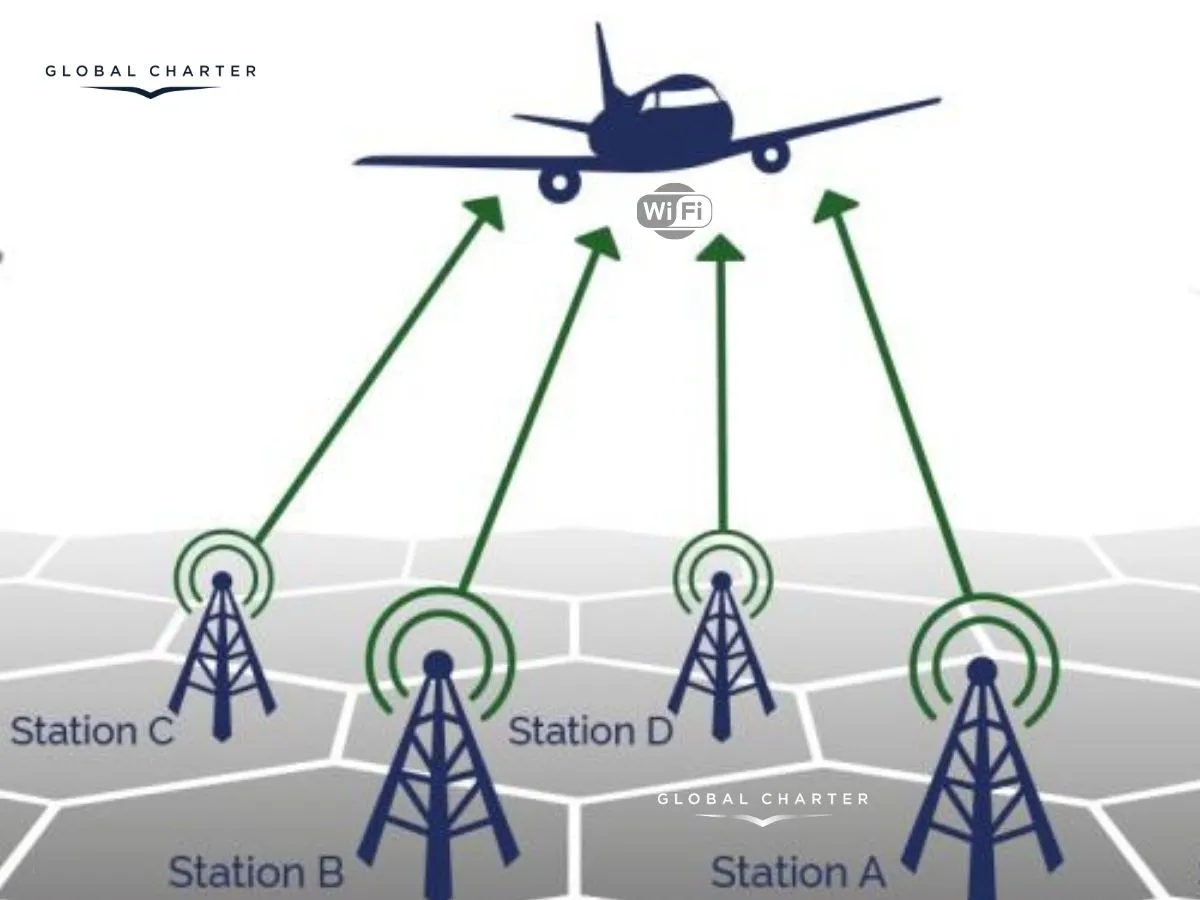
Air-to-ground systems use antennas mounted on the aircraft to connect to terrestrial cellular towers. This approach relies on ground infrastructure and is primarily used for flights over land within range of network coverage.
Satellite-based systems connect the aircraft to orbiting satellites, enabling connectivity across virtually all flight routes, including oceanic and remote regions. These systems are commonly installed on mid-size and long-range private jets.
Within satellite connectivity, there are two main network types. Geostationary (GEO) satellites have traditionally been used across business aviation, providing broad coverage through high-orbit positioning. More recently, low-Earth orbit (LEO) constellations such as Starlink Aviation have been introduced, using a larger number of lower-altitude satellites to support continuous coverage.
How Fast Is Wi-Fi on a Private Jet?
Wi-Fi speeds on private jets vary depending on the onboard system and aircraft type. Air-to-ground systems typically deliver speeds of around 3–10 Mbps – suitable for email, messaging, and light browsing, but can become limited when multiple users are connected or when attempting more data-intensive activities.
Traditional satellite systems generally provide 10–40 Mbps, supporting standard business use such as video calls and cloud-based applications, although performance can fluctuate depending on demand and coverage.
Newer low-Earth orbit systems such as Starlink Aviation can deliver 40–220 Mbps in optimal conditions, with significantly lower latency than traditional satellite networks. This enables a more seamless experience for high-bandwidth activities such as video conferencing, streaming, and real-time collaboration tools.
How Much Does Wi-Fi Cost on a Private Jet?
The role that Wi-Fi plays in private jet charter costs varies depending on the aircraft and onboard connectivity system. In many cases, it is included within the overall flight cost, though in some circumstances it may be billed separately depending on usage or operator policy.
On some aircraft, particularly smaller jets or more cost-sensitive operations, Wi-Fi may be subject to usage-based charging. This can range from approximately $200 to $1,000 per flight, depending on data consumption and the extent of high-bandwidth usage such as streaming or video conferencing. In some legacy satellite systems, connectivity may also be billed by data usage, with reported industry ranges of approximately $3–$10 per MB, although this model is becoming increasingly uncommon in modern charter operations.
Latest Connectivity Trends in Private Aviation
Starlink is increasingly establishing itself as the benchmark for private jet connectivity, particularly on long-range and premium aircraft. Its low-latency performance and higher bandwidth capacity have redefined expectations around what reliable in-flight internet should deliver, especially for passengers using the aircraft as a fully functional workspace.
This shift is driving a broader change in buyer behaviour, with connectivity now playing a role in aircraft selection at the quotation stage. Alongside range, cabin configuration, and aircraft age, Wi-Fi capability is increasingly factored into decision-making, particularly where consistent performance for video conferencing and cloud-based tools is required.
At Global Charter, we’ve seen almost a 25% increase over the past 12 months in clients specifically requesting Starlink-equipped aircraft, most notably on transatlantic and other long-range missions where uninterrupted connectivity is a priority.
This demand is being reinforced at fleet level, with major operators already committing to large-scale adoption. For example, Netjets is rolling out Starlink across approximately 600 aircraft, signalling a clear shift toward high-speed connectivity becoming a standard feature rather than a premium upgrade.
FAQs About Private Jet Wi-Fi
Do all private jets have Wi-Fi?
Not all private jets are equipped with Wi-Fi. While many midsize and large-cabin jets now offer connectivity as standard, some smaller or older aircraft may have limited or no internet access. It is always best to confirm availability at the quotation stage.
Can I video call on private jet Wi-Fi?
Video calling is possible on many private jets, but performance depends on the onboard system. Satellite-based Wi-Fi generally supports video conferencing reliably, while air-to-ground systems may struggle with consistent performance. Newer systems such as Starlink offer the most stable experience for real-time calls.
What affects Wi-Fi performance on a private jet?
Performance depends on the connectivity system, aircraft type, route, and passenger demand. Air-to-ground works best over land, while satellite systems provide wider coverage but variable speeds depending on usage and location.
How We Handle Wi-Fi When Arranging a Charter
At Global Charter, Wi-Fi availability is always clearly indicated at the quotation stage. Each option specifies whether connectivity is included, not included, billed separately, and whether the aircraft is equipped with systems such as Starlink.
Where any additional usage-based costs may apply, these are established in advance of booking to ensure full transparency before confirmation.
We are also flexible with aircraft sourcing, allowing us to prioritise connectivity requirements alongside other mission criteria. This ensures clients are matched with the most suitable aircraft for their journey, particularly where reliable high-speed connectivity is a key requirement.
If reliable onboard Wi-Fi is a priority for your next private jet charter, request a quote with Global Charter and our team will help source the right aircraft with full transparency on connectivity options before booking.