


How Far Can a Private Jet Fly?
Private jets can fly anywhere from around 1,000 nautical miles (1,85 km) to more than 8,000 nautical miles (approx. 15,000 km), depending on the aircraft. Smaller jets are generally suited to regional journeys, while the longest-range private jets can connect destinations such as London and Singapore or New York and Dubai nonstop.
However, an aircraft's published maximum range is not a guarantee of how far it can fly on every journey. Passenger numbers, luggage, weather conditions and cruising speed all affect achievable distance. Understanding these factors is essential when selecting the right aircraft for a private charter.
How Far Can a Private Jet Fly Without Refuelling?
Private jet range varies considerably between aircraft, with the most capable models able to remain airborne for well over 15 hours.
These are indicative published maximum ranges across each aircraft class, not guaranteed distances for individual flights. Actual nonstop capability depends on payload, weather, fuel requirements and other operating conditions.
What Affects a Private Jet's Range?
Several factors influence how far a private jet can fly in practice, from the weight of passengers and luggage to weather conditions, cruising speed and the fuel required for a safe journey. Understanding how these factors interact helps explain why an aircraft's achievable range may differ from its published maximum.
Passengers, Luggage and Payload
The more weight an aircraft carries, the more fuel it generally consumes. Passenger numbers, luggage and specialist equipment can therefore influence its nonstop range.
Aircraft also have maximum take-off weight limits, meaning there can be a trade-off between the amount of fuel carried and the available payload.
For example, Pilatus publishes a range of 2,000 nautical miles for the updated PC-24 with six passengers, but a fully loaded aircraft cannot necessarily carry the same quantity of fuel or achieve that distance.
This becomes particularly important when arranging longer flights for larger groups or passengers travelling with substantial luggage. An aircraft capable of completing a route with four passengers may require a fuel stop when carrying eight.
Weather and Wind Conditions
Wind is one of the most significant variables affecting the distance a private jet can cover. A strong tailwind increases an aircraft's speed over the ground, allowing it to travel further in a given period. Headwinds have the opposite effect, increasing the time and fuel required to reach a destination.
This is particularly relevant over the North Atlantic, where prevailing westerly winds often favour eastbound flights towards Europe. Two journeys between the same airports can therefore have different fuel requirements depending on their direction, the season and the conditions on the day.
Flight planning must also account for weather-related diversions, air traffic restrictions and routing that may add distance compared with a direct geographical path.
Cruising Speed and Altitude
Flying faster does not necessarily mean travelling further. Private jets typically achieve their greatest range at an economical cruising speed rather than their maximum speed. Increasing speed generally raises fuel consumption, reducing the distance achievable without refuelling.
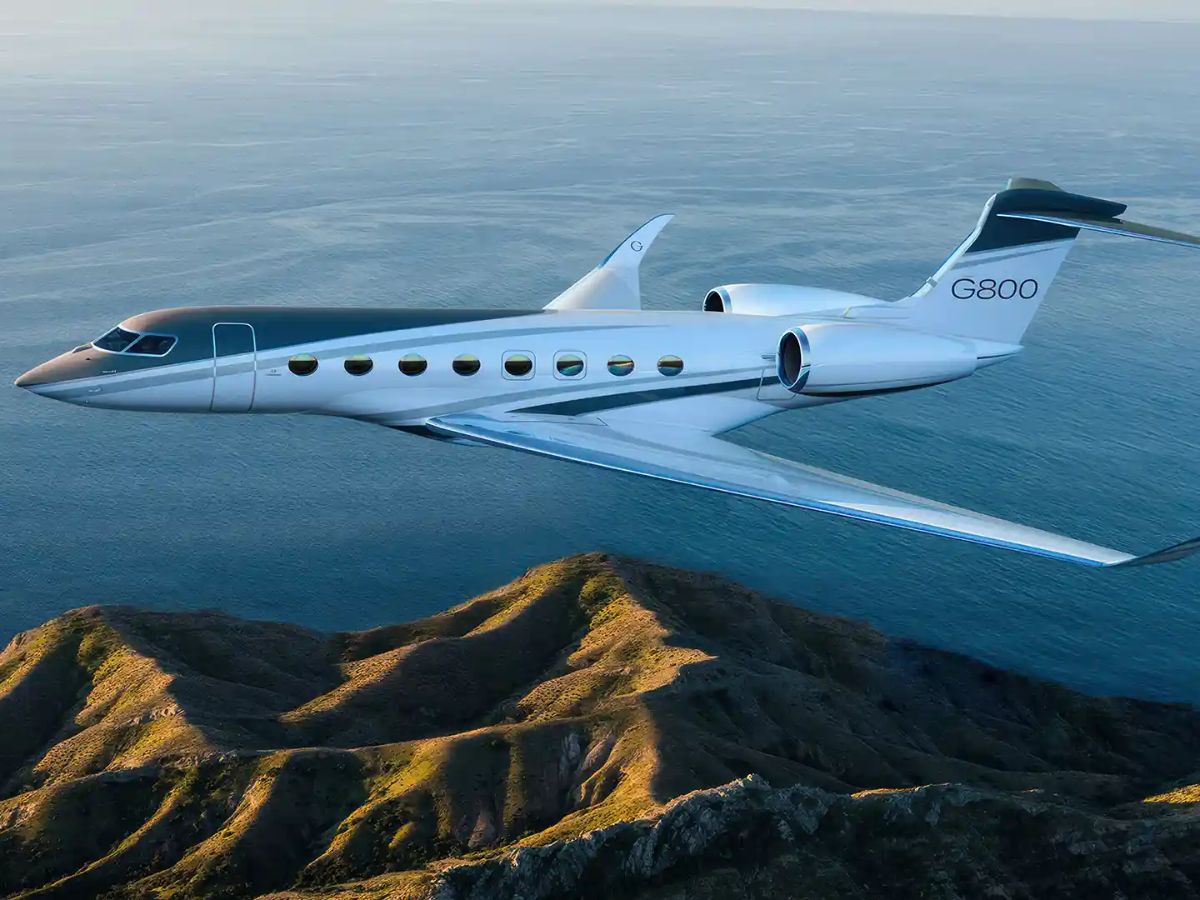
The Gulfstream G800 demonstrates this distinction particularly clearly. Gulfstream publishes a maximum range of 8,200 nautical miles at Mach 0.85, compared with 7,000 nautical miles at the faster cruising speed of Mach 0.90.
That represents a difference of 1,200 nautical miles under the manufacturer's specified conditions.
This trade-off between distance and journey time is an important consideration when assessing how fast private jets fly.
Altitude also influences fuel efficiency. On longer journeys, aircraft may climb progressively higher as they burn fuel and become lighter, a technique known as step climbing.
The most efficient altitude depends on aircraft weight, atmospheric conditions and air traffic restrictions. As explained in our guide to how high private jets fly, the highest available cruising altitude is not necessarily the most efficient at every stage of a flight.
Fuel Reserves and Flight Planning
An aircraft cannot simply use all its available fuel to maximise the distance flown.
Flight plans must account for regulatory fuel requirements and operational contingencies, including the possibility of diverting to another airport, unexpected delays or adverse weather.
Many manufacturer range figures already include defined fuel reserves. However, the assumptions used to produce those figures may differ from the requirements of a particular journey.
For example, a flight with limited diversion options or challenging weather at its destination may require additional fuel.
Can a Private Jet Fly Across the Atlantic Nonstop?
Yes. Many super-midsize and long-range private jets can complete transatlantic private jet flights without refuelling, although this depends on the route, weather conditions and aircraft capabilities.
For example, London to New York is approximately 3,000 nautical miles, within the published range of aircraft such as the Praetor 600. However, prevailing headwinds on westbound flights can make the journey more demanding, meaning an aircraft capable of flying nonstop eastbound may require a fuel stop in the opposite direction.
Ultra-long-range aircraft such as the Bombardier Global 7500 offer considerably greater flexibility, with sufficient range to complete most transatlantic routes nonstop.
What Happens When a Private Jet Needs to Refuel?
If an aircraft cannot safely complete a journey nonstop, a planned fuel stop may allow it to operate a route beyond its normal nonstop range.
These stops are generally arranged at an airport along the flight path where suitable fuel, ground-handling services and operating permissions are available.
During the stop, passengers will usually be able to remain on board where local procedures permit, although immigration requirements, crew arrangements or other operational considerations may require them to disembark.
The time required varies depending on the airport, fuel availability, ground handling and any additional services needed.
A fuel stop can significantly extend the overall journey, accounting for descent, landing, refuelling and departure. Although a smaller aircraft requiring a stop may offer a lower charter price, a longer-range jet can sometimes provide better overall value through reduced travel time. For this reason, nonstop capability can be more important than maximum cruising speed when selecting an aircraft.
How Does Global Charter Assess Nonstop Flight Capability?
At Global Charter, we assess aircraft suitability based on the requirements of each journey, rather than relying solely on published range figures. Our brokers consider the route, passenger numbers, luggage, preferred airports and schedule before identifying suitable options from our global network of operators.
For longer flights, we work closely with operators to establish whether an aircraft can complete the journey nonstop under the anticipated conditions. Where a route approaches an aircraft's operational limits, we may recommend a longer-range jet or compare the benefits of a planned fuel stop.
As an independent charter broker, we are not tied to a particular fleet. This allows us to compare aircraft on their practical suitability, availability and cost, helping clients make informed decisions about their journey.